In a nutshell
- 🌿 Explains phototropism and auxin-driven lean, showing how uneven light gradients and differing DLI warp growth, heat, and transpiration across a plant’s canopy.
- 🔄 Shows how regular space rotation averages hotspots and shadows to achieve even light distribution, producing tighter internodes, squarer canopies, and simpler maintenance in homes and grow tents.
- 🗓️ Outlines practical schedules: quarter-turn every 2–3 days for windowsills, weekly half-turn plus position swap for tents, fortnightly reshuffles for big tubs, and very slow motorised platforms—emphasising consistency over perfection.
- ✅ Highlights Pros vs. Cons: symmetry, colour uniformity, airflow sharing vs. bud sensitivity, handling stress, and hygiene risks; includes a concise checklist for safe, effective turning.
- 🐢 Clarifies why more spin isn’t better: plants integrate light over hours, so avoid rapid reorientation; manage mechanical stress and thigmomorphogenesis with gentle, well-timed moves or ultra-slow continuous rotation.
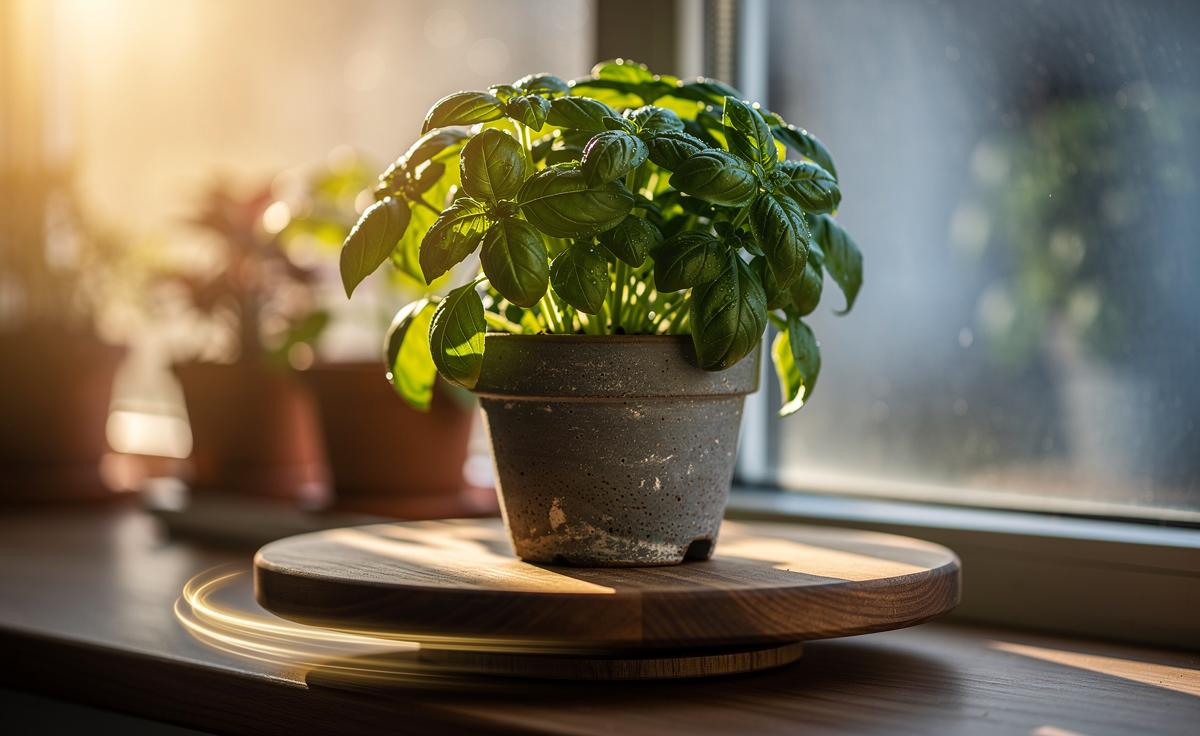
Gardeners know the quiet drama of a windowsill: one week of bright weather and your basil is pitching itself towards the glass, while the shaded side stretches thin. The simple remedy is the “plant turn” — a small, regular twist of the pot — which leverages space rotation to average out hotspots and shadows. By sharing light across all sides, rotation promotes even light distribution, tighter internodes, and a balanced canopy. Because light is rarely uniform in homes or grow tents, turning plants is one of the most effective low-tech fixes you can make. Here’s how and why it works, when it doesn’t, and the practical routines that slot neatly into a busy week.
Why Plants Lean: Phototropism and the Light Gap
Plants don’t “prefer” one side; they’re obeying phototropism, redirecting growth hormones (notably auxin) to elongate tissue away from the light-poor flank. In a bay window or beneath a single LED board, intensity falls off quickly with distance and angle, creating a steep light gradient. The near side fattens and stays compact while the far side stretches, and leaves twist to maximise capture — a form of living geometry. Left uncorrected, this bias compounds each week, widening the gap between sunny and shaded tissues.
Uneven light also warps microclimates. The bright flank runs warmer, transpires faster, and receives a higher daily light integral (DLI); the dim flank sits cooler and slower. Over time you see asymmetrical internode length, patchy leaf size, and imbalanced root-to-shoot ratios. Worse, once a plant leans, it self-shades its own lower tiers, reinforcing the skew. The aim of space rotation is simple: time-average these differences so that, over several days, every quadrant experiences a similar light budget, stabilising growth and colour across the whole canopy.
The Case for Space Rotation in Homes and Grow Tents
Space rotation is the routine repositioning of containers in a room, greenhouse, or tent so no plant lives forever in a hotspot or a dead zone. A fortnightly shuffle between centre and edge, plus a small in-place turn, can equalise PAR exposure remarkably well. On a windowsill, a quarter-turn every few days stops the classic “crescent” silhouette; in tents, swapping front and back rows counters door-side losses and reflections. Rotation is a low-cost, high-impact intervention that upgrades the efficiency of whatever light you already own.
In my notebook from a spring trial, 12 chilli seedlings under a single fixture were split: six were left static; six were quarter-turned daily and swapped edge-to-centre weekly. After four weeks, the rotated group had visibly squarer canopies and tighter nodes; leaf-size variance dropped by roughly a third and stake corrections were almost unnecessary. While that’s not a lab study, it mirrors what many growers report: uniform canopies make pruning, feeding, and pest checks faster — and harvests more consistent.
Best Rotation Schedules at a Glance
Choose a schedule that fits your light pattern and life pattern. South-facing windows with patchy sun benefit from frequent, small turns; stable LED arrays respond well to weekly shuffles. Consistency beats perfection: the right routine is the one you’ll actually keep. If watering days anchor your calendar, piggyback your turn on that task. For large containers, use a low-friction pad or “lazy Susan” to avoid jolting roots.
| Schedule | Typical Move | Best For | Advantages | Watch-outs |
|---|---|---|---|---|
| Every 2–3 days | Quarter-turn (90°) | Windowsills; mixed houseplants | Smooths daily sun shifts; easy habit | Can disrupt plants in active bud set |
| Weekly | Half-turn (180°) + position swap | Grow tents; veg stage | Balances centre-edge intensity | Remember to rotate row positions too |
| Fortnightly | Full turn + row reshuffle | Large tubs; woody herbs | Lower handling stress | Slower to correct leaning |
| Motorised platform | Very slow continuous spin | Specimen plants; exhibition | Ultra-even exposure with no reminders | Cost; ensure stable, slow RPM |
Pros vs. Cons of Turning Plants
The strengths are compelling. Turning evens out light distribution without buying new gear, encourages symmetrical root anchoring, and reduces the need for corrective pruning. It helps prevent soft, leggy growth on the shaded side, and can normalise colour — chlorosis patches often reflect low DLI rather than nutrition alone. In clustered plantings, rotating pots between micro-zones shares airflow and humidity too, lowering the odds of mildew pockets. For many UK homes with changeable skies, rotation is a tidy way to “average out” a fickle week.
There are trade-offs. Frequent handling can disturb delicate trichomes, wobble tall stems, or misalign training ties. Some species — notably orchids and African violets — resent abrupt reorientation in bud and may abort flowers. Rotating straight after watering risks compressing wet soil, and constant fidgeting can escalate pest spread if tools or hands aren’t clean. The remedy is moderation and hygiene: plan turns, keep notes, and adjust frequency during bloom or stress.
- Checklist: Turn when soil is slightly dry; support stems; clean hands/tools; log the direction and date; pause during heavy bloom; resume gently post-harvest.
Why More Spin Isn’t Always Better
Plants integrate light over hours, not seconds. Over-rotation — especially rapid or random spins — can outpace the leaf’s ability to adjust its angle and chloroplast orientation. That muddles photoreceptors and wastes metabolic effort, producing neither compact growth nor true balance. As a rule of thumb, changes should be measurable in days, not minutes. In practice, that means quarter-turns spaced out, or a very slow continuous platform where a full revolution takes many hours or a day, not minutes.
Mechanical stress matters too. Repeated nudging triggers thigmomorphogenesis, making stems stockier — sometimes useful, sometimes not. In fruiting crops, sudden reorientation can change light and heat on developing trusses, nudging split rates or sunscald. If you stake or trellis, synchronise the turn with re-ties so tensions don’t yank at nodes. For wide, top-heavy pots, rotate by sliding the platform, not by twisting the stem, and verify the canopy still clears neighbouring leaves to avoid new shade problems.
Uniform growth is a journalist’s favourite quiet success: small habits, big returns. By using space rotation to average hotspots and shadows, you carve order out of Britain’s erratic daylight and make your lighting pound go further. Start modestly — a marked pot, a note on watering day, a gentle quarter-turn — and observe how stems square up, colours deepen, and maintenance gets simpler. The smartest growers are the calmest observers. Which plant on your sill or in your tent would benefit most from a steadier share of light, and what turning rhythm could you commit to this week?
Did you like it?4.4/5 (22)