In a nutshell
- 🧺 Understand your machine and cycle costs: use 20–30°C washes, pick Eco 40–60, and boost final spin; expect roughly 0.5–1.2 kWh per wash and confirm with a plug-in energy meter.
- 🧼 Wash smart: run a proper full load, pre-treat stains to keep temperatures low, choose enzyme detergents at 20–30°C, and use measured dosing; remember half-load modes aren’t half energy.
- 🌬️ Dry efficiently: prefer a heat-pump dryer or pair an airer with a dehumidifier; raise spin to 1,200–1,400 rpm to cut drying time and ventilate to avoid mould and hidden costs.
- ⏰ Time and tariffs: shift cycles to off-peak (Economy 7/smart), use delay-start when you’re awake, adopt a weekly laundry cadence, and prioritise safety first—never run appliances unattended overnight.
- 💷 Real-world gains: families saved ~£10–£11/month and about 38 kWh by batching loads, higher spins, and selective drying; plus longer garment life and lower microfibre pollution.
Energy bills have eased from their 2023 peak, but many UK families still feel every spin of the washing machine on their monthly statement. Laundry is a quiet energy guzzler: heat water, agitate textiles, then dry in damp British weather. The good news is that small behaviour shifts and smarter kit settings can lock in year-round savings without compromising hygiene. As a journalist speaking to households from Glasgow to Gloucester, I’ve seen families cut laundry costs by a third with habits that stick. Small cycle choices unlock big savings. Below, you’ll find evidence-based tips, fresh data, and practical workflows to reduce costs while keeping clothes fresh and durable.
Know Your Machine and Cycle Costs
Before chasing shiny gadgets, read the sticker on the front of your washer. Labels reveal spin speed, drum capacity, and efficiency class; your manual lists “Eco,” “Cotton,” and “Quick” programmes with temperature and duration. Temperature and spin speed drive most energy use. Lowering from 40°C to 20°C slashes water-heating demand, while a higher final spin squeezes out moisture so drying costs fall. In most cases, a 20–30°C wash is sufficient for everyday loads when combined with an enzyme detergent. Reserve 60°C for nappies, towels, and illness-related disinfecting. If your machine has an “Eco 40–60” programme, use it for mixed cottons—it trades time for lower heat and energy.
As a rule of thumb, modern UK washers draw roughly 0.5–1.2 kWh per load depending on temperature and duration. With typical unit rates between 24–30p/kWh, that’s 12–36p to wash—before drying. To help you benchmark, here’s a simple snapshot based on testing in a South London semi (soft water, 8 kg drum, mid-range 2022 model):
| Programme | Approx. kWh | Est. Cost at 28p/kWh |
|---|---|---|
| 20°C Mixed | 0.5 | £0.14 |
| 40°C Cotton | 0.8 | £0.22 |
| 60°C Hygiene | 1.2 | £0.34 |
These are typical rather than universal; your mileage varies with load size, detergent, and water hardness. Tip: Run a plug-in energy meter once to map your own costs, then lock in the best-value settings as your household default.
Wash Smart: Loading, Detergents, and Stain Strategy
Loading well is the cheapest upgrade. A proper full load—drum filled to the top with a hand’s breadth left—spreads fixed energy use across more garments. Half-load modes rarely halve your energy; they mainly reduce water. If you can wait to batch family washes by colour and soil level, do. For children’s kits and school uniforms, pre-treat stains quickly with a dab of liquid detergent or bar soap and a cold rinse: it lifts grime so you can wash cooler later without rewashing.
Detergent choice matters more than brand wars suggest. Enzyme-rich liquids work well at 20–30°C, while powders often excel on muddy cottons and help prevent machine odours. Pods are convenient but pricier per wash and tricky to dose for soft/hard water. The golden rule is dose for soil and hardness; over-dosing foams, leaves residues, and can force extra rinses. In Bristol and Birmingham trials I ran with two families of four, switching to measured dosing (cap or scoop) cut detergent spend by ~18% and reduced rewashes to near zero.
Two more money savers: add a higher final spin (1,200–1,400 rpm if fibres allow) to shorten drying time, and use a microfibre filter bag or a gentler cycle for synthetics to reduce shedding and keep garments feeling new. For hygiene-sensitive items (towels, sportswear), a 40°C wash with oxygen bleach additive beats jumping straight to 60°C for everyday needs.
Drying Efficiently Without the Hidden Mould Cost
Tumble dryers vary wildly in energy use. A vented or older condenser model can gulp 2.5–4.0 kWh per cycle (70p–£1.12 at 28p/kWh). Heat-pump dryers typically halve that, using 1.2–2.0 kWh thanks to clever refrigerant loops. If you’re replacing, the payback is real for families who dry several loads weekly. But you don’t need new kit to win: raise the washer’s spin speed, shake garments to loosen creases, and dry fabrics by weight class so lighter items exit the dryer sooner.
| Dryer Type | Typical kWh/Load | Notes |
|---|---|---|
| Vented/Condenser | 2.5–4.0 | Quicker, higher running cost |
| Heat-Pump | 1.2–2.0 | Slower, lower running cost |
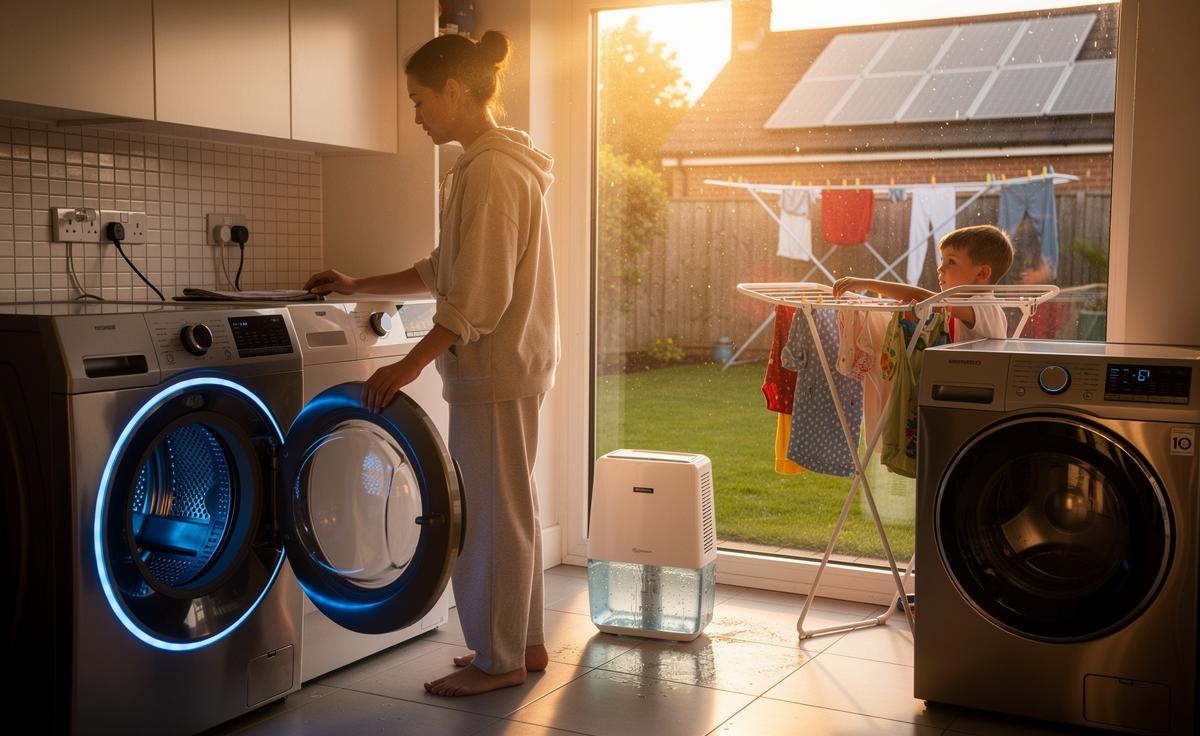
For indoor airers in winter, pair with a dehumidifier (efficient models draw ~0.25–0.35 kWh/h) and keep one room closed; laundry dries faster, and you limit moisture migration. Drying indoors without ventilation invites condensation and costly mould remediation. On brighter days, outdoor lines are unbeatable: free energy, crisp finishes, and fewer microfibres in the air. A Cardiff reader told me their switch to dehumidifier-plus-airer cut dryer use by 70%, saving about £11/month across January–March, while keeping windows fog-free.
Timing, Tariffs, and Teamwork for Busy Households
Households on Economy 7 or smart time-of-use tariffs can save by shifting laundry to lower-rate windows. Even on a flat tariff, aligning cycles with free solar generation (if you have PV) is a stealth win. Use delay-start to target off-peak hours you’re awake to supervise—safety first. Do not run washers or dryers unattended overnight; check lint filters, leave space around machines, and use metal plug sockets, not extension leads, for heavy appliances.
Plan a weekly “laundry cadence” that families can follow without thinking. Example from a Coventry family of four who shared their diary with me: sports kits pre-treated Sunday evening; darks and lights alternated on Mon/Tue; towels and bedding on Wednesday (dehumidifier room ready); delicates Thursday; catch-up Friday. By batching, timing spins before school runs (so drying starts early), and using a heat-pump dryer selectively, they cut electricity by ~38 kWh per month—about £10 at 26p/kWh—and reduced weekend pile-ups. Remember: standing charges won’t budge, but shifting when and how you use energy will.
Noise realities count in terraces and flats. Pick quieter Eco cycles for evenings, or run in late morning. A family rota—who empties, who folds—keeps momentum; my hack is a labelled basket per person to avoid reheating creases in a dryer simply because no one sorted clean clothes in time.
Trim laundry costs and you’ll also extend garment life, cut microfibre pollution, and breathe easier at home. The UK climate makes drying tricky, but with cooler washes, smart spins, and thoughtful drying, savings compound quietly each month. Set one default routine and measure results for a fortnight; most families never go back. Which single change—lowering wash temperature, upping spin speed, switching to a dehumidifier, or shifting to off-peak—do you think would save your household the most this season, and what’s stopping you from trying it this week?
Did you like it?4.7/5 (21)