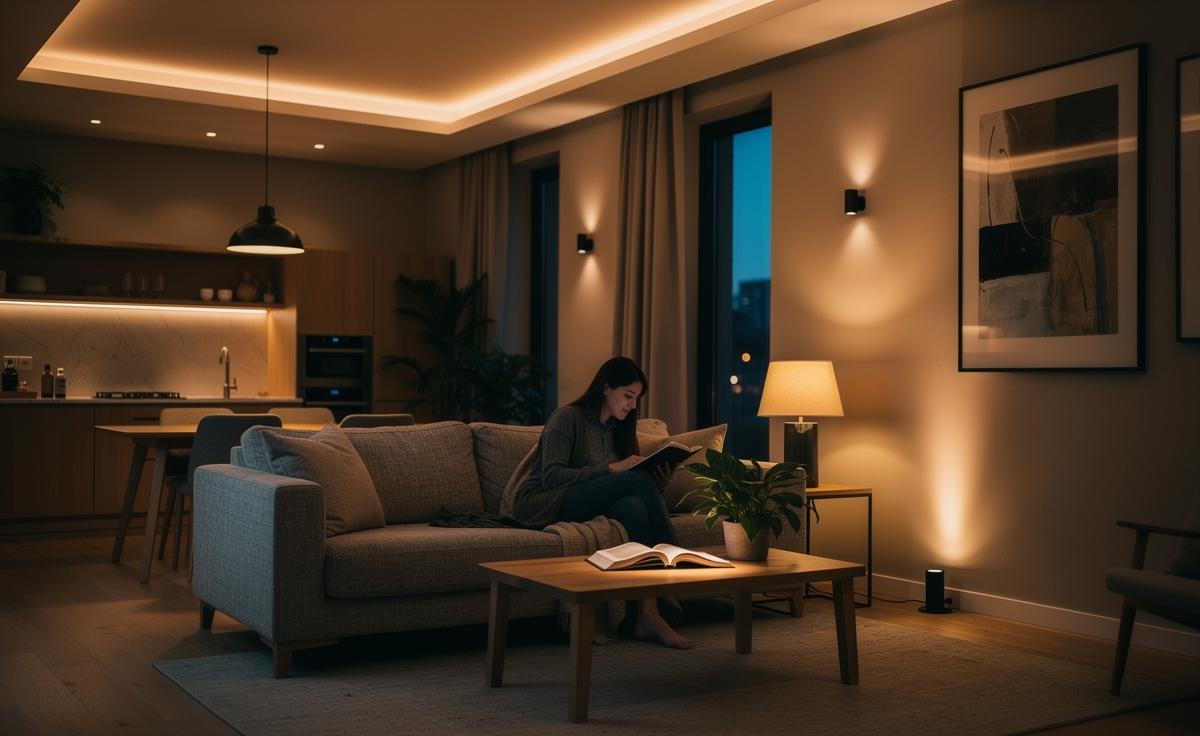
In a nutshell
- 🧠 The physiology: Circadian rhythm responds to light; evenings feel calmer with warm CCT 2700–3000K, high-CRI, low-glare, flicker‑free sources.
- 🧩 Layered layouts: Combine Ambient base, Task pools, and Accent highlights for flexibility and calm—single overheads aren’t enough.
- 🌾 Placement and materials: Prioritise indirect lighting, vertical illumination, and matte finishes with good LRV; wall washers and uplighters reduce harsh contrasts.
- ⏱️ Controls and routines: Use dimmers, scene presets, timers, and smart plugs; map switches to behaviours and add motion-lit guides for safe, soothing transitions.
- 🎯 Quick wins: Add one uplight, a shaded lamp, and a dimmer; renters can use a torchiere and clip‑on picture light; pick 2200–3000K for evening calm and avoid bare LEDs at eye level.
Walk into some homes and your shoulders drop within seconds. The reason is rarely the sofa or the scent; it’s the lighting layout. Subtle choices in placement, brightness, and colour tone cue your nervous system that it’s safe to exhale. As a UK journalist who’s spent years in show homes, rentals, and quietly brilliant council retrofits, I’ve learned that the most relaxing rooms share a few repeatable patterns. The trick isn’t buying expensive fittings; it’s orchestrating light to guide the eye, soften contrast, and support your body clock. Below, I unpack the science, the craft, and the small changes that turn a house into a haven—complete with examples, a quick-reference table, and the pitfalls professionals quietly avoid.
The Science of Soothing Light
Relaxation starts with biology. Our circadian rhythm entrains to light: cooler, brighter light nudges alertness; warmer, dimmer light signals wind-down. In practice, evening rooms feel calmer when color temperature (CCT) sits around 2700–3000K and brightness is kept moderate with layered sources. Harsh, overhead-only lighting spikes visual contrast, flattens skin tones, and keeps the brain on guard. Designers also watch for invisible irritants: micro-flicker from cheap drivers, low CRI that muddies colours, and high glare from bare bulbs or shiny diffusers. Even the direction matters—our vision relaxes when more light lands on vertical surfaces (walls, shelves) rather than exclusively on floors.
On a recent visit to a renovated terrace in Leeds, the owner swapped a single pendant for a trio of wall washers and a shaded floor lamp. Nothing else changed, yet the room’s mean brightness dropped while the perceived spaciousness rose. Why? Vertical illumination expands edges; soft, indirect light calms the eye by avoiding hotspots. Small, reliable upgrades include flicker-free drivers, 90+ CRI lamps, and shielding any line-of-sight to LED points with baffles or opal diffusers.
- Do: Warm-white lamps, indirect beams, dimmable circuits.
- Don’t: Bare LEDs at eye level, one-size-fits-all brightness, low-CRI bargain bulbs.
Layered Layouts: Ambient, Task, and Accent Working in Concert
The rooms that instantly soothe rarely rely on a single fitting. They stage three roles: ambient (the base wash), task (focused pools for reading or chopping), and accent (drama and depth). Light that soothes is almost never a single overhead source. In a Hackney flat I covered last winter, the homeowner kept her ceiling rose but demoted it—on a low-dim circuit—then added a shaded table lamp beside the sofa and a picture light over a print. The ceiling faded into soft presence; the eye landed on warm focal points, and conversations naturally clustered in the cosier corners.
Think choreography: ambient from coves or shaded pendants sets the stage; task from under-cabinet strips or swing-arm lamps supports precision; accent from wall washers or niche spots shapes mood. The win is flexibility. A living room can shift from family play (brighter ambient, softer accent) to film night (ambient down, accent up). Layering gives you a dimmer for your day, not just your lights. If budget is tight, start with two layers: a floor lamp for ambient bounce and a single task light by your favourite chair—you’ll get 80% of the feel for 20% of the cost.
Placement and Materials: How Geometry and Surfaces Calm the Eye
Relaxation depends as much on where you put light as which light you buy. Aim beams at walls and ceilings to create indirect lighting and even wall washing. This lowers contrast ratios and removes “glare traps” caused by bright fittings against dark ceilings. In kitchens, under-cabinet strips that graze the splashback light your worktop while avoiding eye-level hotspots. Where light lands is as important as how bright it is. Surfaces matter too: matte paints with mid-to-high Light Reflectance Value bounce light softly; high-gloss units reflect points and can feel jittery unless you diffuse sources expertly.
Two common fixes pay off fast. First, swap downlights near walls to adjustable wall washers; the same wattage feels calmer because you’re brightening the room’s edges. Second, add a slim uplighter in a corner to “lift” the ceiling. For renters, a torchiere floor lamp and a clip-on picture light can simulate built-in schemes without drilling. Pros vs. cons when choosing layouts:
- Indirect first: Pros—softer, spacious feel; Cons—requires bounce-friendly surfaces.
- Downlight grids: Pros—uniform task light; Cons—flat, clinical mood, risk of glare.
- Accent-led: Pros—character, calm focal points; Cons—needs base ambient to avoid gloom.
Smart Controls and Routines: Relaxation on a Schedule
Even the best layout unravels without control. Dimmers, scene presets, and simple timers align light with your day. I’ve seen renters achieve hotel-level calm with two smart plugs: one schedules a warm floor lamp to meet them at the door; the other fades bedside lights over 20 minutes to cue sleep. Automatic, predictable transitions tell your body it can power down. If you can splurge, circadian bulbs that gently warm after sunset reduce the mental load of fiddling. For families, a “settle” scene (ambient 30%, accents 60%, tasks off) lowers noise and invites reading without arguments.
Controls also prevent the classic mistake: blasting the big light because your hands are full. Map switches to behaviour, not fittings—entrance switch for ambient low, sofa switch for accent, kitchen switch for task. Keep it simple to avoid “control fatigue.” And remember safety: stair treads love low-level guide lights on motion sensors—calm and practical. When budgets are tight, analogue rules: fit dimmable warm lamps and put them on two circuits so you can sculpt atmosphere without tech.
| CCT Range | Perceived Feel | Best Uses | Notes |
|---|---|---|---|
| 2200–2700K | Cosy, intimate | Bedrooms, lounges, evening scenes | Great with indirect lighting; enhances wood and skin tones |
| 2700–3000K | Warm, relaxed focus | Living rooms, dining, mixed-use | Good all-rounder; pair with dimmers |
| 3500–4000K | Fresh, alert | Kitchens, utility, home office (daytime) | Soften with wall wash to prevent starkness |
The magic of soothing homes isn’t magic at all; it’s method. Combine warm, high-CRI light with layered placement, minimise glare, and give yourself intuitive control. Warm, indirect, and adjustable beats bright, direct, and fixed. Start small—one uplight, one shaded lamp, one dimmer—and observe how your evenings change over a week. From terraces in Leeds to new-builds in Kent, I’ve watched these tweaks tame echoey rooms and shorten the distance between front door and peace. What single lighting change will you test first to make your home feel instantly more relaxing?
Did you like it?4.6/5 (23)